
Investigating Existing Structures Before Design
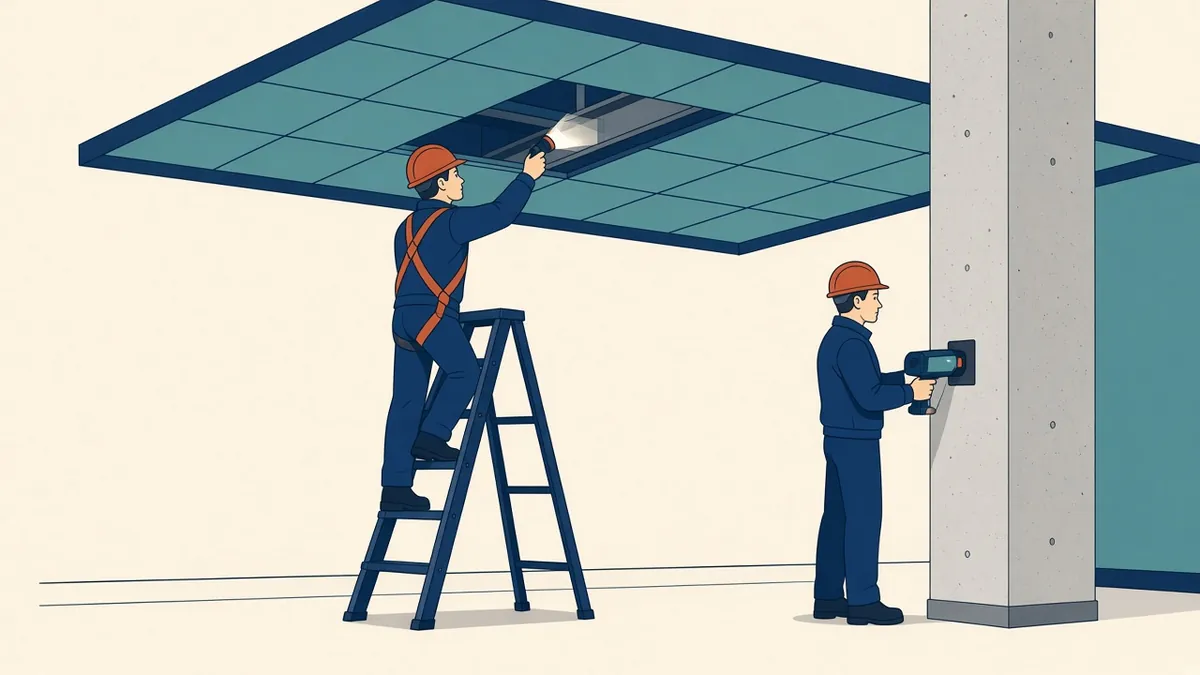
Before changing an existing building, you need to know what's holding it up.
Altering an existing building depends on understanding its structure. Records may be missing or wrong, and hidden conditions are common. Investigation before design reduces surprises during construction.
Record searches
- Original drawings
- Previous alteration drawings
- Building control or permit records
- Structural calculations, if available
Treat records as a starting point, not proof.
Visual inspection
A walk-through identifies structural elements, visible defects, signs of movement and areas needing closer inspection.
Opening-up works
Opening-up exposes hidden structure, such as removing finishes to reveal beams, joists or connections. It's planned with the structural engineer and may need permission in listed or occupied buildings.
Structural surveys
Structural engineers assess:
- Structural system and load paths
- Member sizes and materials
- Condition and defects
- Capacity for proposed changes
Testing
Some projects need testing, such as concrete cores, rebar scanning or timber condition assessments. Specialists carry these out.
Hazardous materials
Older buildings may contain hazardous materials, such as asbestos. Surveys for these are often required before intrusive works.
Recording findings
Record findings in drawings and models, noting:
- Which elements were confirmed
- Which were assumed
- Defects and their locations
Modelling uncertainty
Models of existing structures should show confidence levels. Assumed elements can be tagged or noted so the team knows where risk remains.
Coordination with design
Structural findings affect design options. Share them early with the whole team.
During construction
Further conditions often appear during works. Plan for a process to record and respond to them.
Heritage buildings
Investigation in historic buildings should minimise damage and follow conservation guidance.
Planning investigations
Agree what needs to be found out, where and why. Targeted opening-up in a few key locations often gives more useful information than widespread disruption.
Occupied buildings
In occupied buildings, investigations need careful planning around users, with dust, noise and safety controlled.
Updating the model
As investigations reveal more, update the model and the assumption log, so the design team always works from the latest information.
- 01Record searches
- 02Visual inspection
- 03Opening-up works
- 04Structural surveys
- 05Testing
- 06Hazardous materials
Sharing results
Issue a short summary of each investigation to the whole team, with photos, locations and what changed in the model, so nobody designs from out-of-date assumptions.
Careful structural investigation supports safe, realistic designs for existing buildings.
If your team needs extra production capacity for work like this, take a look at our Architectural production services, or tell us about your project.
Related articles
Measured Building Surveys Explained
Survey methods, deliverables and how to specify what you need.
Read more →
Scan to BIM for Existing Buildings
Turning laser scans of existing buildings into reliable BIM models.
Read more →
Modelling Historic Buildings Accurately
Irregular geometry, detail levels and heritage records.
Read more →